Little People Fighting Forever
I've been playing a lot of lately. It's a fun game; most people describe it as "Mount & Blade in space" and while that can lead to some wrong assumptions when experiencing the game for the first time, it's useful enough to get an idea of what it's like.
In Starsector, you start off as the captain of a small fleet, doing odd jobs here and there while getting (optionally) involved in RPG missions to get enough money to grow your fleet and broaden your opportunities. Exploration, bounty hunting, trade - and trade's edgier brother, smuggling - even covert missions acting on behalf of one faction to disrupt another; it's all fair game. And as you can imagine, there's a lot of combat.
Moving around and interacting with the world map is separate from combat, like in classic RPGs. When encountering an enemy fleet (or a fleet you'd like to make your enemy), you can choose - or have - to engage them, bringing you to a small map where you choose which ships to deploy from your fleet.
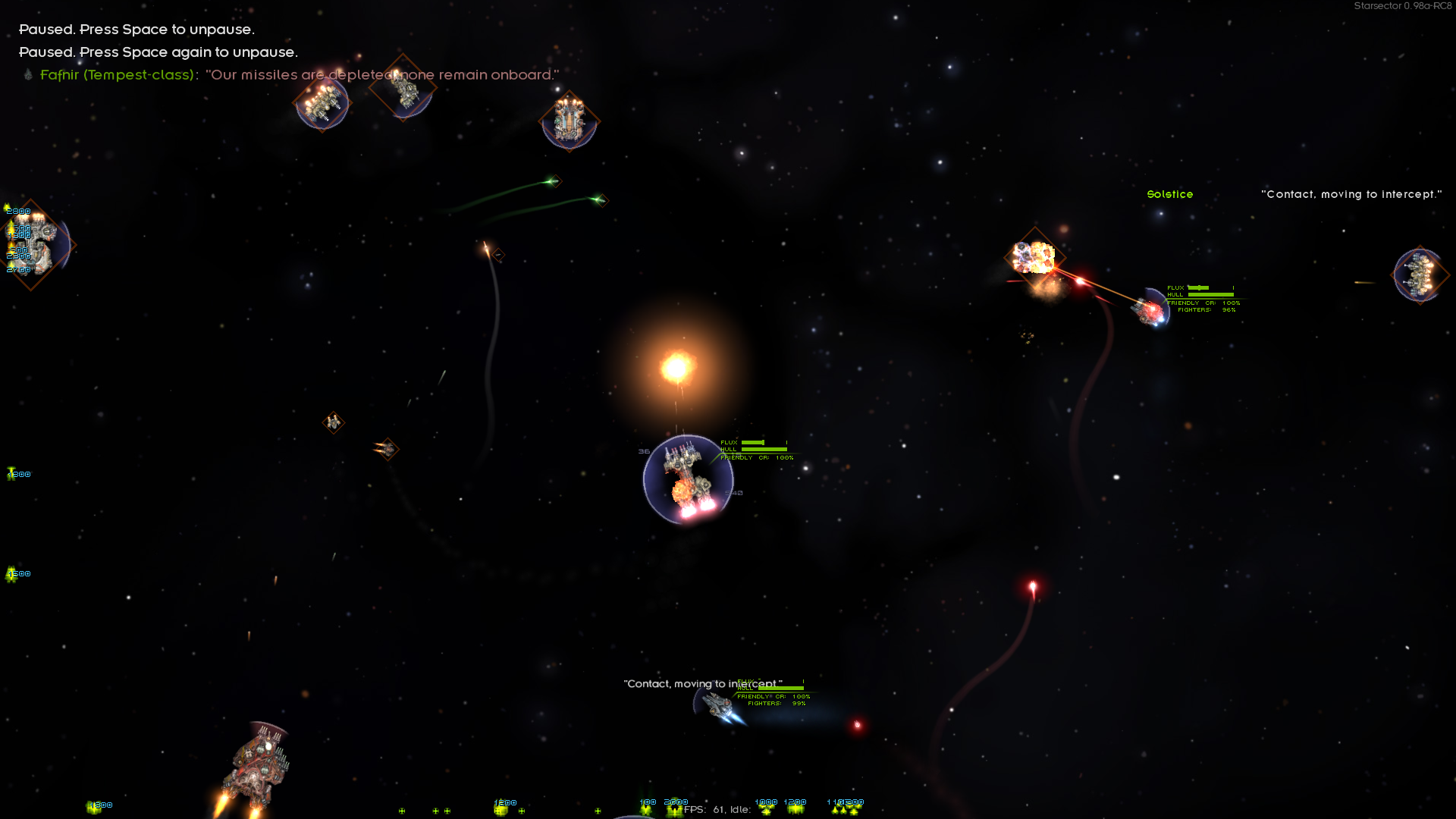
Starsector, Fractal Softworks
What interests me most about these fights is the fact that while you can give orders to your deployed ships after sending them out, you don't have to - and even then, unlike in traditional Real-Time Strategy games, ships will still act reasonably; they'll protect themselves as much as they can, they'll avoid going in a straight line towards an objective if it'll clearly lead to their doom (unless the order is specifically to recklessly attack a specific target), etc...
And when not given an order, they'll do whatever makes the most sense for them: they'll push forward if it isn't too risky or fall back if their defenses are getting overwhelmed by enemy fire, and while they won't take any strategically genius actions, you can get away with not giving your fleet any orders at all when facing off against a weaker foe. Orders are really for when you're dealing with someone your size (or bigger). And even then. You could always just take control of one ship to directly pilot it...
not that I do that because I suck at piloting these things.
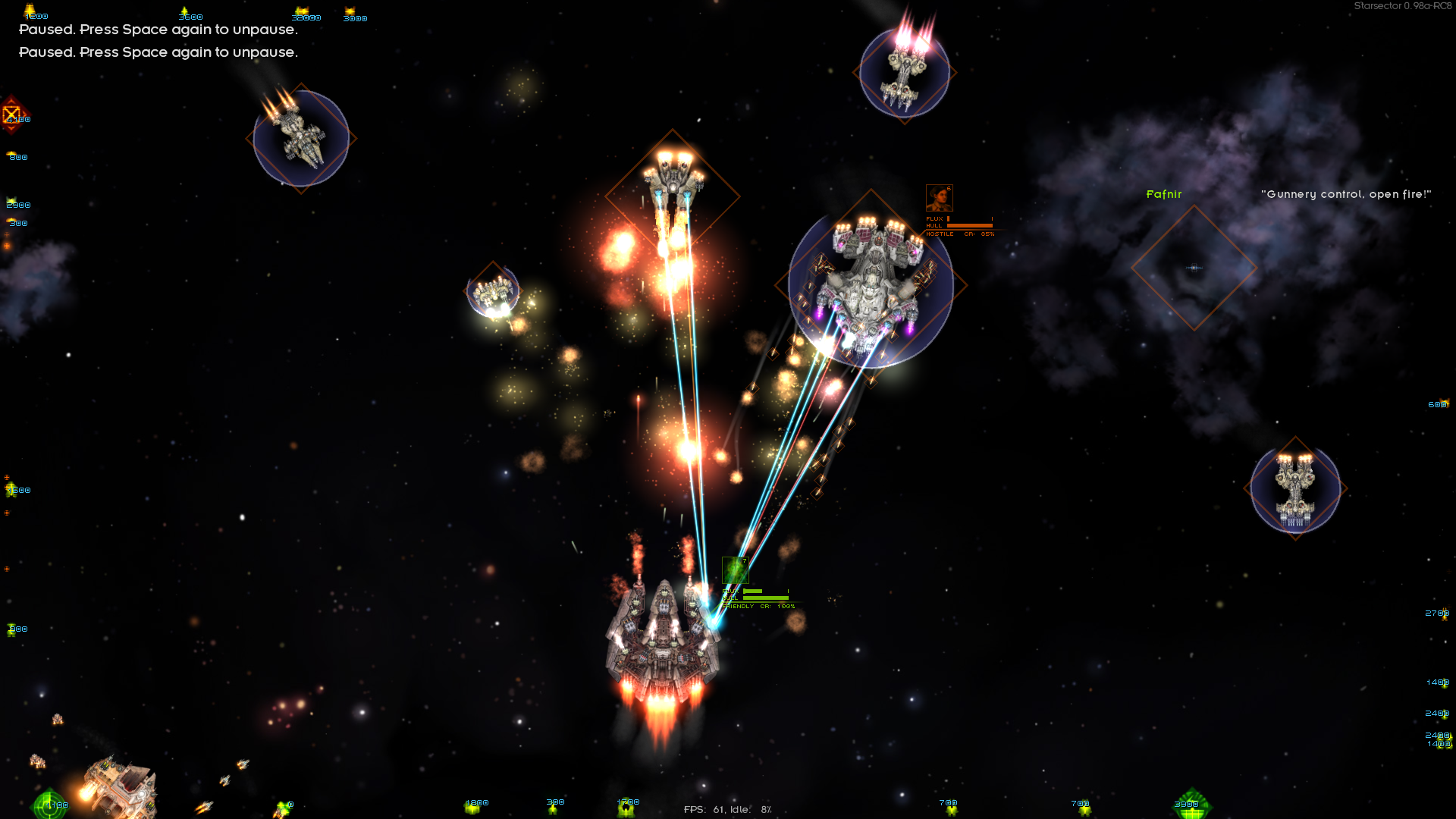
Some ships will take unecessary risks if the officers piloting them are reckless, something you can plan for in advance.
I find this sort of hands-off strategic gameplay thrilling. Sitting back to watch the fireworks, only occasionally giving a few orders if things are looking particularly messy.
...But why? Aren't I just choosing to play less of the game like this? Considering in a good few battles, I never even give a single order, am I even playing to begin with? What kind of gameplay even is that? Real-Time Strategy? Backseat Simulator?
This is something I've noticed enjoying a lot in many games - that is to say, 'little people fighting'. I've "coined" this term in my head whenever I encounter something in a game that vaguely fits that vibe of letting me enjoy the sights of a large-scale battle with minimal - but not zero - input, and today I'd like to walk you through some examples of what I mean, and maybe get to a deeper point along the way. Maybe.
I'm kind of winging it here, I'm not a professional writer this is just a personal blog for me-
REAL-TIME TOWERING
The earliest games that suscitated this sort of enjoyment from me were probably Tower Defense games, which I played a LOT of as a kid on Flash game sites. In fact, I still really like TD games - although I don't play them much anymore. In Tower Defense games, you usually handle most of the strategy before any enemies arrive for you to deal with. Sure, you might have a few "special powers" you can activate during an enemy wave, and you can build a few extra defenses while invaders are pouring in if you're noticing specific areas lacking, but usually it's much wiser to actually set things up first.
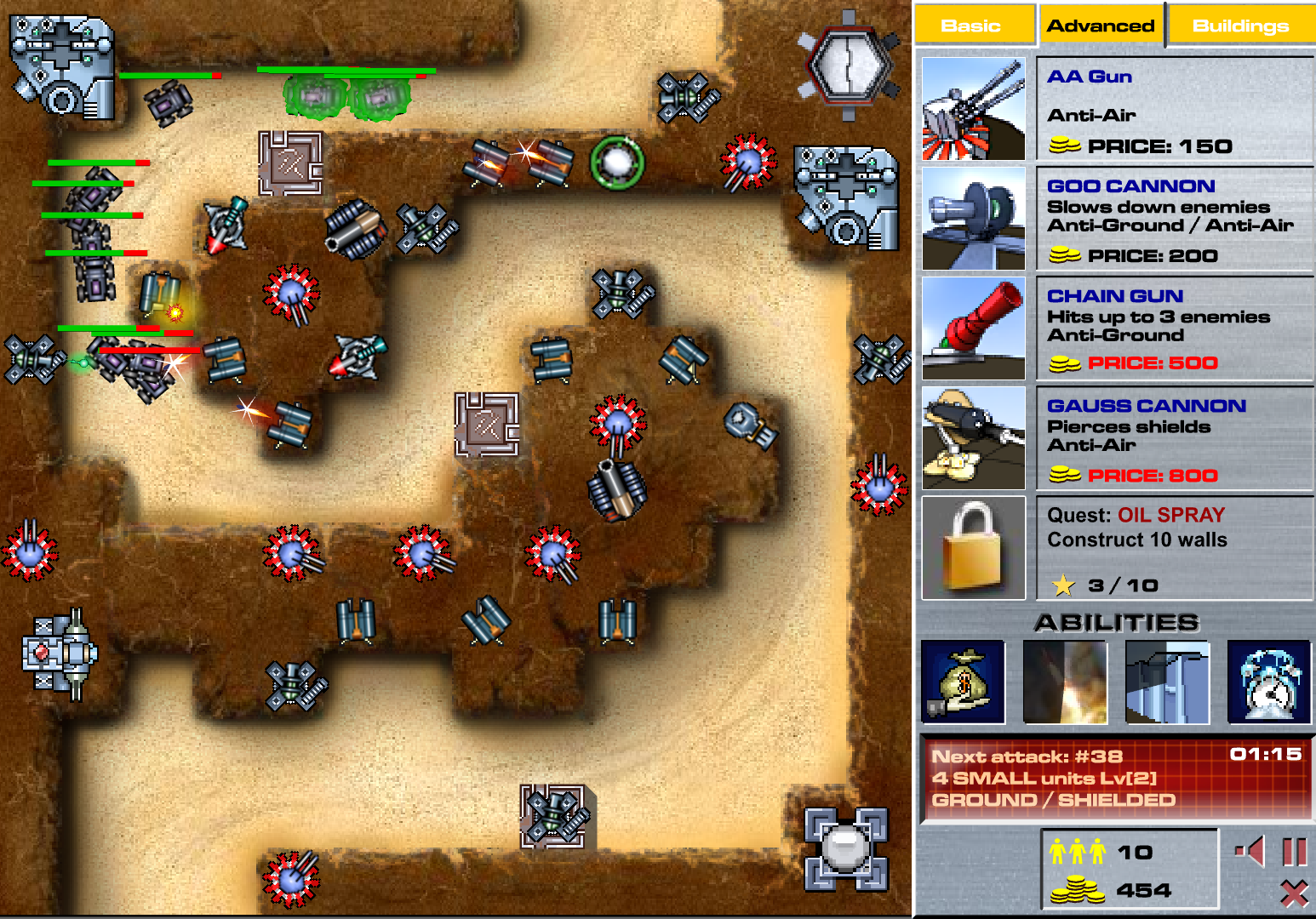
Canyon Defense, IriySoft
Because of that, in a lot of cases, you just set up your towers on the map, call the next wave of enemies when you're done, and then watch them all helplessly perish against your mighty defenses - or, if you have the same strategic mind as me, panic as you realize you really overestimated how good any of what you've made is. It's a nice part of Tower Defense games that you might recognize from how I've described Starsector battles. You set up, click play, and watch it all happen.
There are some elements of Little People Fighting in there too, what with the autonomous towers that react to and attack enemies completely or mostly on their own, and some games such as push that further by having certain towers summon little soldiers that are designed to fight approaching enemies to hold them back while damage-focused towers take care of actually killing them.
But that isn't enough for me!! I need the people fighting to be the MAIN THING! In most Tower Defense games, your towers don't get attacked! The enemies just ignore them! And even if they do, it's clearly not an equal playing field here! I don't want tiny towers blowing up little people! I want LITTLE PEOPLE FIGHTING! I WANT WAR! I WANT WAR FOREVER!
Tower Defense games aren't the ideal, but they're a step in the right direction.
Maybe if we looked at Tower Defense's older sister, we'll get closer to the blood-soaked dream I seek.
Real-Time Strategy is pretty self-explanatory, and also way too vague of a term to be meaningful in any way. Am I not using strategy when I plan my next move in literally any other video game? Not that we're here to deliberate on the nonsense that is game genres and their names
- although we definitely could -
RTS games are usually about war, controlling large (or not-so-large) armies of sometimes-people to throw at one another, right?
Well, that seems like exactly what we're looking for, and games with very high unit count even provide a truly amazing spectacle of constant death! One of my favourite RTSs, , seems to be specifically built around spectacle. What the game lacks in pure graphical fidelity, it makes up for in numbers alone; thousands of units can be rendered at any one time, all fighting each other on the same battlefield, countless robots dying over and over again... It's absolutely beautiful.
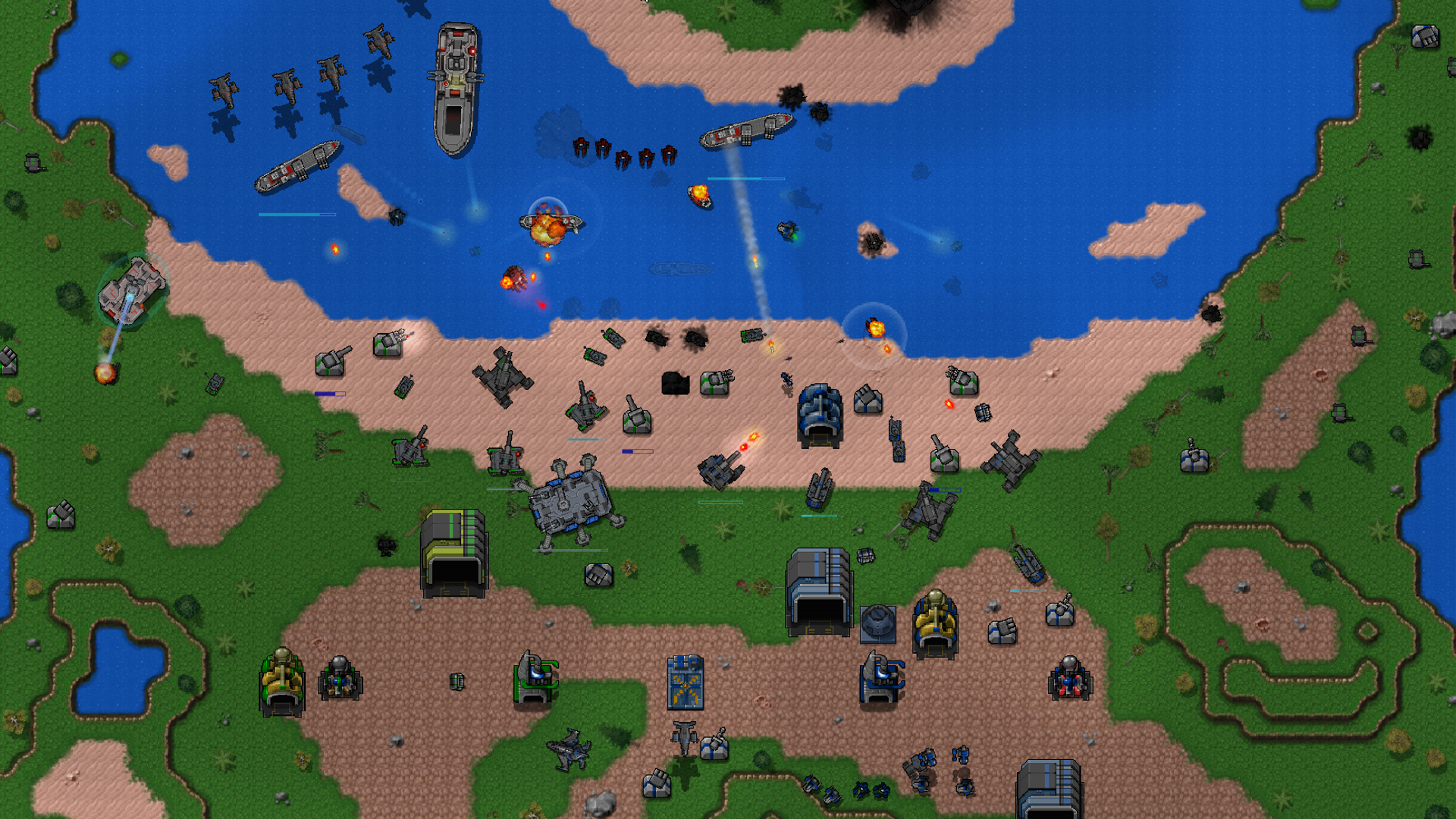
Rusted Warfare, Corroding Games
But while I love that part of RTS games, another part irks me whenever I attempt to play them: micro-management. Even in a fairly simple game such as Rusted Warfare, I often end up getting overwhelmed by having to manage multiple different fronts, knowing what units to send here or there, telling others to attack this specific enemy, or this one, or... you get it. It can feel overwhelming because of how much control it demands of me. I'm in charge of everything!
Truly, my favourite command in those games is "move to this location and attack anything on the way there". SO nice! I can just build up a massive invading force and them all at once and forget about it? AWESOME! And I know how much I love that command because everytime I've tried playing an RTS game that didn't have it, it'd feel so off! I really truly hate micro-managing. I just want to step back and look at the battlefield but I HAVE to stay alert! It sucks.
Thankfully, there's allies. The problem is much lesser when I'm playing with other people or AI-controlled factions. I can just let THEM handle all the bad stuff while I just watch. Well, I don't only watch. I like to contribute.
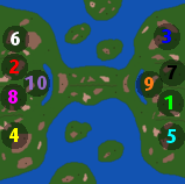
I play a Tower Defense game!
Okay, not exactly, but kind of. Basically, I rush for as many resource spots as I can to build extractors on them (an early-game way to generate money), and then build as many defensive turrets as I can on the crossing in a sort of wall formation, with an opening in the middle to let troops pass through.
This map is perfect for this strategy because it's basically built for it. Only one way for ground troops to go through, meaning I know exactly where most enemies will be coming from and exactly where to build defenses? PERFECT!
There being a structure that repairs anything around it also helps for maintenance of the Wall.
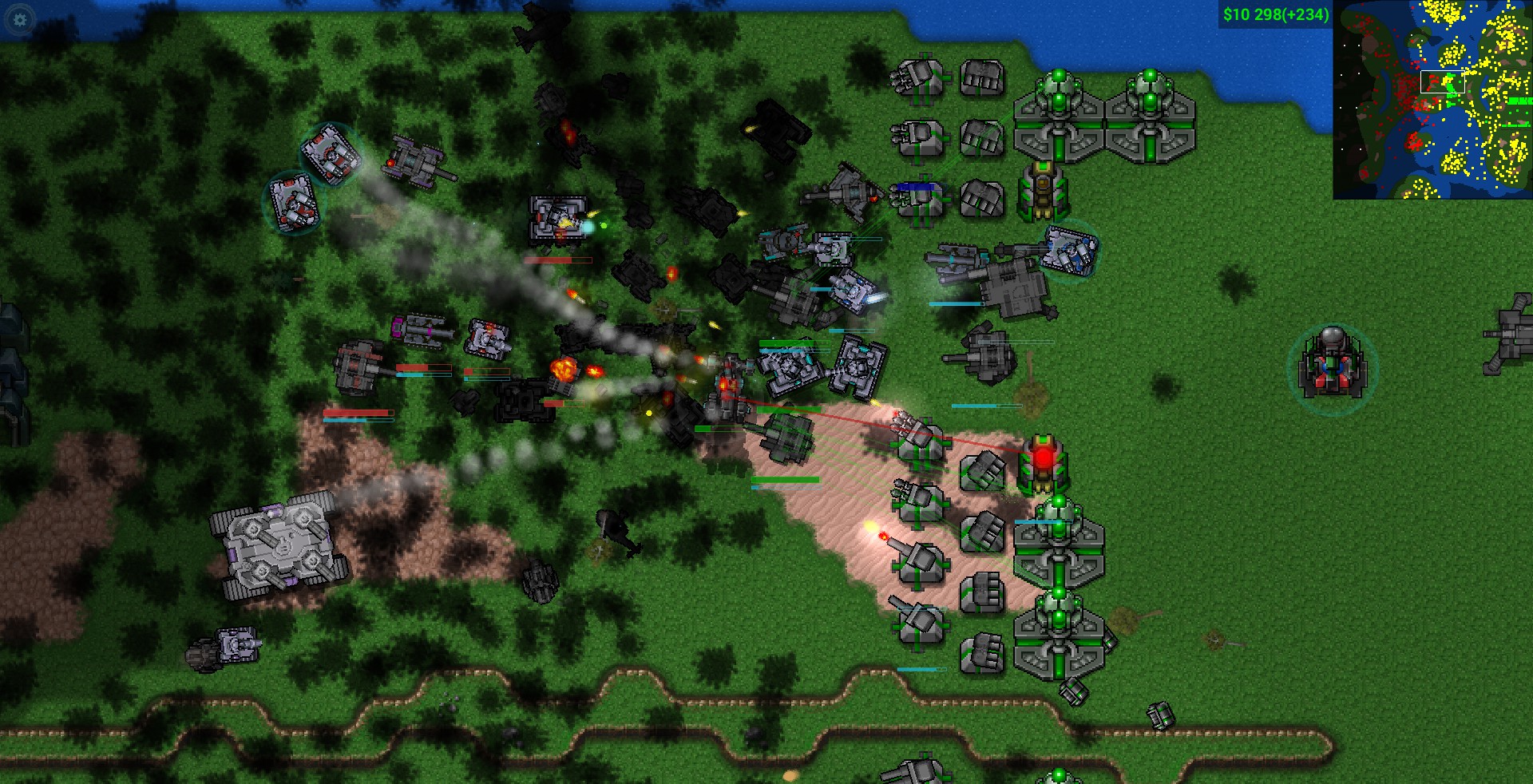
THE WALL
This strategy takes away a lot of the unpleasant kind of stress that comes with micro-managing in RTS games, while keeping the parts of RTSs I DO enjoy! After I've built my Wall of Death, I can watch as my AI allies send their own troops past my defenses, with all the turrets I've built backing them up when enemies get too close. And if I want to join in, I can just build my own army too!
...But it's still not exactly what I want. After all, I still have the trouble of my own troops not being autonomous at all... So I'm relying on my allies to handle all the Little People Sending for war, which means I have absolutely no input on it. And at that point in the game, once The Wall is done, I can basically just hang back and build enough nukes to murder everyone anyways, so... No, it isn't that. Shame.
To go deeper into what I seek, we'll have to go back to Flash games. We'll have to:

- might not be playable on Newgrounds but you can find it on other Flash game hosting sites too -
is a really interesting video game. It's definitely a Real-Time Strategy game - it uses the same visual vocabulary, and even its title appears to be a reference to - but it's described by Chris Wallis, the developer, like so:
"I wanted to merge the game-play of tower defense with tactical elements from real time strategy games. I also needed to keep it simple enough for random people on the internet to pick up and play immediately, and simultaneously deep enough to capture the interest of more hardcore players. I settled on a compromise where the combat is automated, but everything that happens is the result of strategic decisions you make when designing your base."
War games with "automated" combat were actually very popular in that era of Flash games. There are countless examples here, from the classic - a game where you send troops from your base to advance towards the enemy base, with each troop attacking and moving on their own - and Miragine War - a game where you send troops from your base to advance towards the enemy base, with each troop attacking and moving on their own - to a personal favourite series of mine, - a series of games where you send your troops from your base and- you get it.
Interestingly enough, the first two games in that last series actually gave the player a more direct way to interact with the game outside of special powers like rains of arrows, which was a turret they controlled on their base, letting them fire at enemies by aiming up and down with the arrow keys. This element does not appear in games past the second Epic War, showing a desire to move away from players directly interacting with the battlefields.
Obliterate Everything stands out from the gameplay found in this variety of Flash games by leaning into the Real-Time Strategy format without compromising on its Tower Defense roots: the player can build factories that will generate units, and defensive structures that will attack enemies such as turrets, but they don't control anything directly beyond that. All strategy is done through the structures the player decides to build, where to build them, and what upgrades to give them.
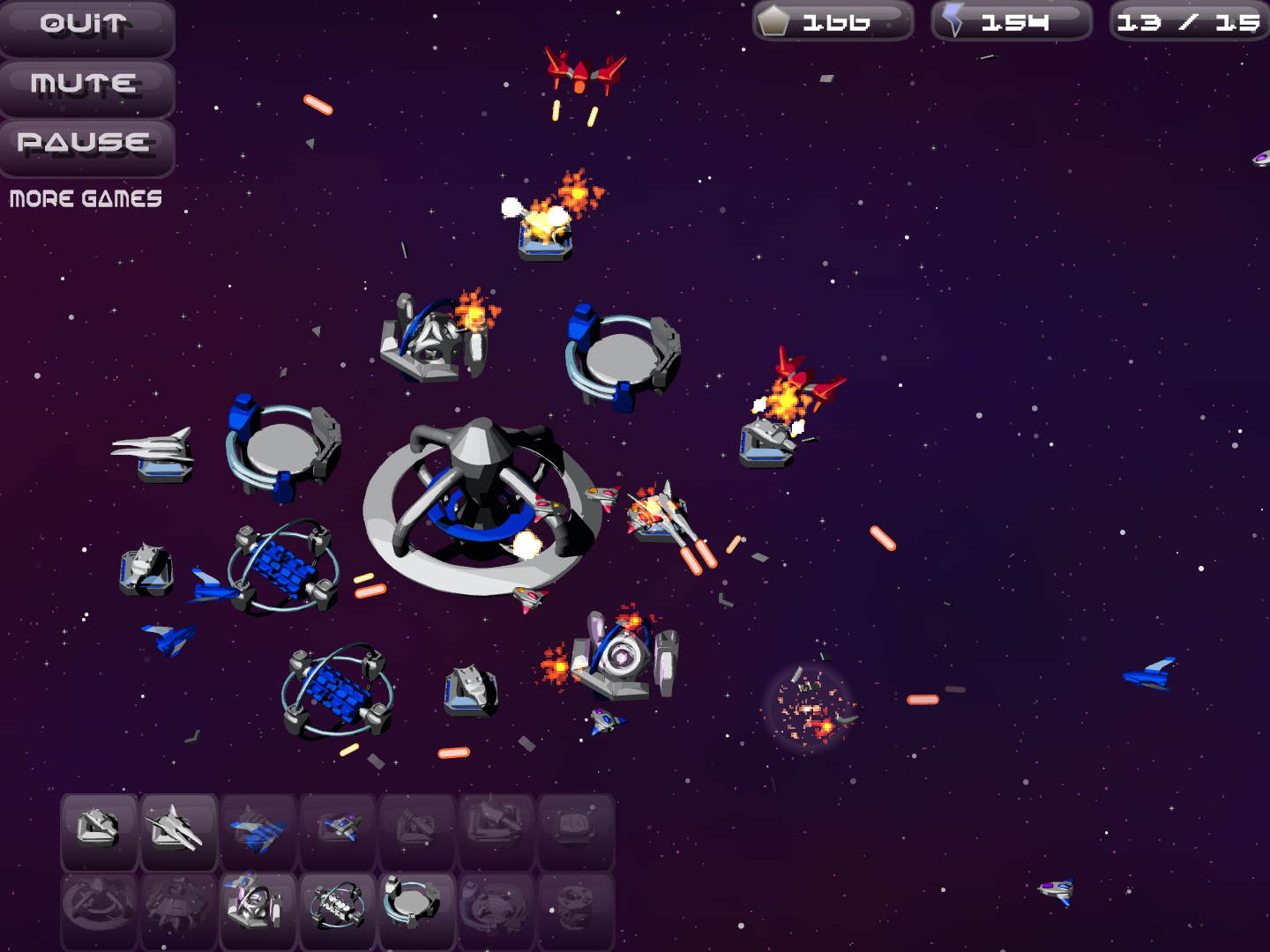
Obliterate Everything, Christopher Wallis (cwwalis on Newgrounds)
Something that is found in both those other Flash games and this one is the symmetry of combat. While player and enemies are very clearly different in what they are capable of doing and what their roles are - that is, assailant and defendant - in these Flash war games, it's very common that the AI enemies have basically the same capabilities as the player. Both you and your adversaries can send out troops, usually the same types of troops, and have the same goal: destroy the opposite side's base.
On top of that, these games usually have a big focus on the spectacle of it all. They know themselves to be quite approachable, at least on first glance, and there will often be moments in them where you won't have much to do but watch the fight go on, so why not make it awesome? "Realistic" blood flying everywhere when a unit gets hurt, some little goblins flying away when a larger golem hits them, limbs going all over the screen, massive explosion PNGs...
Again, here I find Obliterate Everything to excel at this thanks to its setting and classic top-down RTS approach. While in games like Epic War, units are limited to going left and right, and there isn't any flair to them outside of the nice animations they might have when they move, the spaceships in the OE series feel much more alive. They fly all over the place, especially the small fighters, clearly constantly having to adjust where to boost towards to fly in the right direction, going past one another while constantly shooting; the larger ships are much slower to both move and turn and in that way, so much more imposing, as the moment they'll face another unit is when said unit will cease to exist...
In short, they all feel like actual spaceships! This is something I don't see even in a lot of big, commercial RTS games - likely because they focus much more on micro-management, and it is harder to micro-manage something that has to account for 0 friction - this focus on just how impressive and alive battles can feel, instead of simply toys a child is throwing at one another.
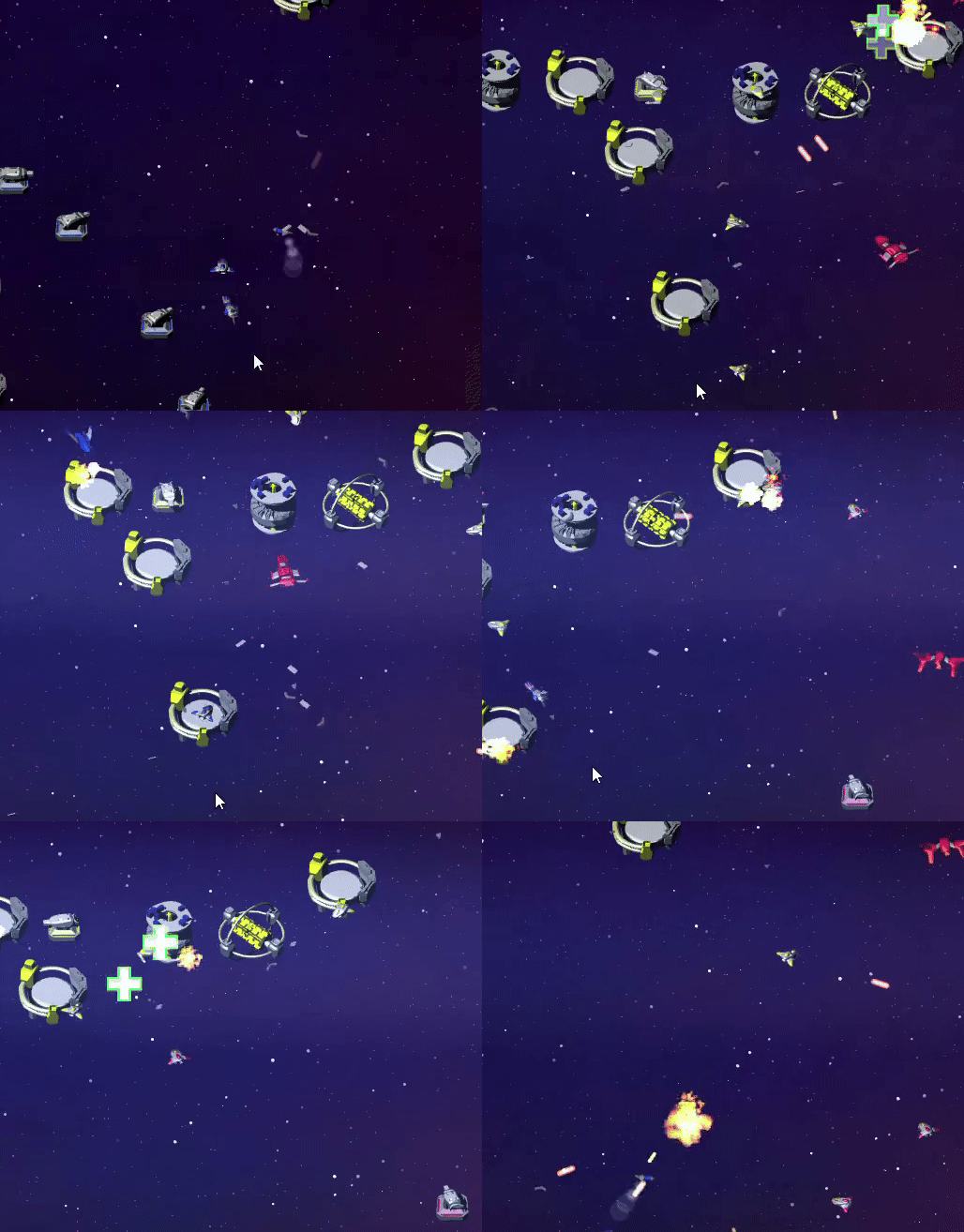
I think that's the key to all this. I don't want the units to just be autonomous. It's great if they are, but that's not enough. I want them to feel like... they are what they are! Little People Fighting! Not just toys. Living things that just so happen to only exist so they can die.
But hey, isn't that what we are anyhow?
Obliterate Everything accomplishes this with flying colours, and I'd say is the first game that started to make me think about this topic. I encountered it when I was younger and the fact that the ships moved like that, on their own, without me having to tell them to do anything? That made me so excited about game design!
But can we go further than that?
We've opened the gates now. We know we can make the Little People active. Alive. But for now, they are naught but micro-organisms designed for eternal bloodshed. How far can we push this? Could we perhaps fashion our own species of living, thinking lifeforms, with hopes and dreams and friends and loved ones, sending them all out to die a terrible death so that our wars may feel as awful and terrifying as possible? Build beasts up from mindless clay, and turn them on one another? Is that truly possible?
BLUE CLAY, RED CLAY
In 2011, the same year that the first Obliterate Everything released, Minecraft Forum user KodaichiZero posted the for Minecraft Beta version 1.7.3.
Clay Soldiers in no way connects to any of the gameplay loops present in regular Minecraft. It's a completely pointless mod if you want to make your experience more efficient, if you want to mine faster, kill more mobs, build bigger castles... all it adds are the titular "clay soldiers", little people made of clay that absolutely despise any of their brethren that aren't the same colour as them. The only purpose of this mod is to watch armies of these small soldiers duke it out until one side is victorious and the other lies still.
In that way, it fits perfectly well with the rest of Minecraft, a game all about building your own structures, about creativity and using the tools at your disposition to do whatever you like. The mod gives you more toys to play with! But those toys are anything but inert.
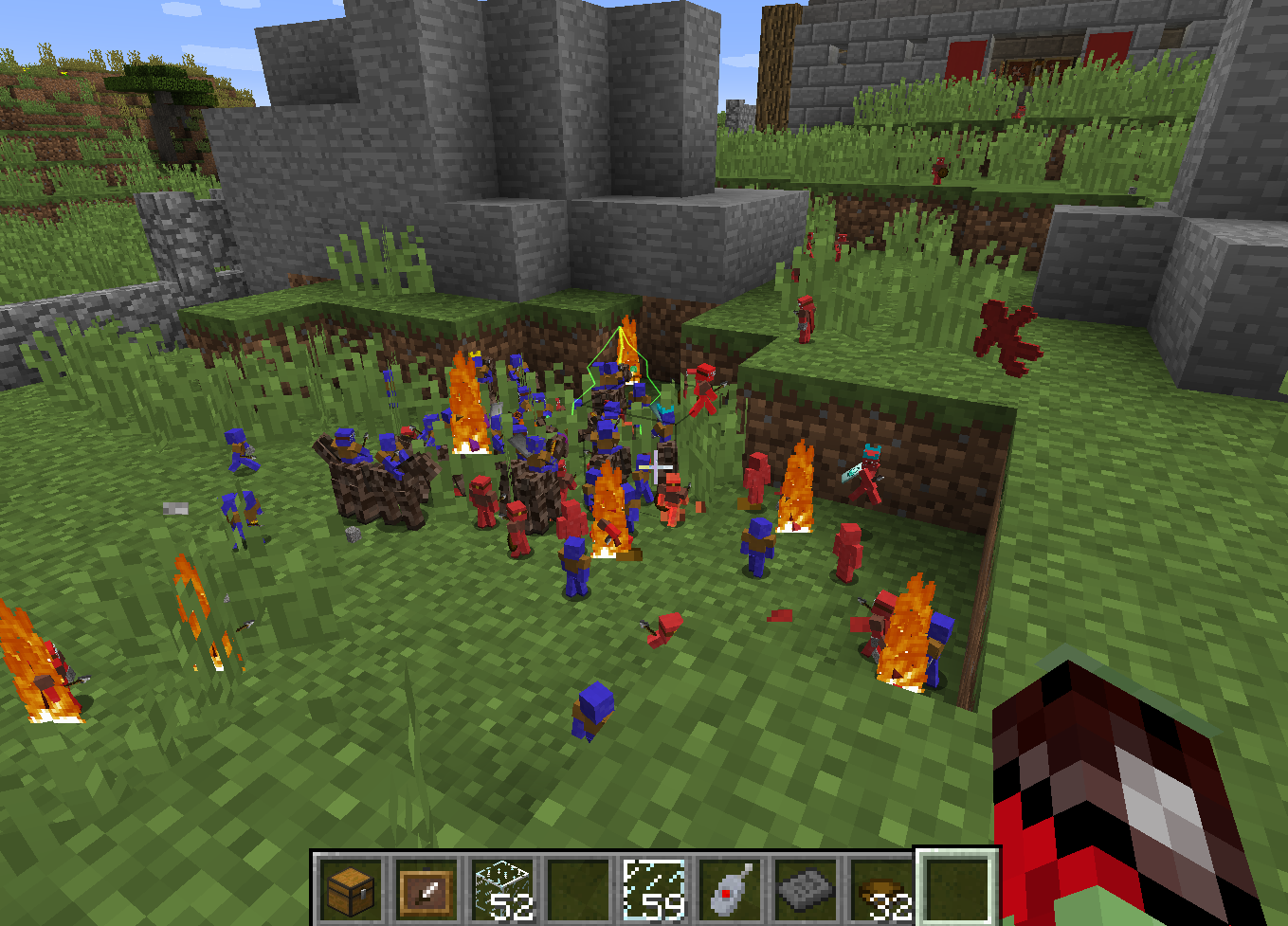
Clay Soldiers Mod, KodaichiZero (original creator), SanandreasP, SilverChiren, and CliffracerX
Clay Soldiers can pick up all sorts of different items that'll give them different effects, from a simple stick that they may use as a weapon to a piece of flint they'll use to sharpen that stick into a spear, even a piece of glass they may fashion into goggles to better see other soldiers who have been given eggs, rendering them invisible. Some items may even change their behavior, like the gold nugget, which when given to a soldier will turn into a crown. Other soldiers of that same colour will from then on follow the newly-crowned monarch, crowding around them to ensure their protection. Hell, they can even be given appropriately-sized clay animals to mount and charge with into battle!
Similarities between this mod and Flash games mentioned earlier are easy to point out; even moreso than before the player has absolutely no control over the soldiers themselves, outside of placing them down and what items to give them - and the arena itself, of course, as building a fitting arena for these clay people to die in is a fun and vital endeavour by itself. However, one key distinction appears here, reflecting the goal of this mod compared to something like Obliterate Everything: the player is in charge of both sides.
This distinction is vital as it shifts the experience from strategy into sandbox. Here, war is more pointless than ever; there isn't even a clear incentive to flex some strategic muscle, only conflict for conflict's sake. For the spectacle of it. Nothing more, nothing less. Of course, you can always invite a friend to play and have you handle a specific colour while your friend is in charge of another, but the strategic element is very... loose.

In fact, I wouldn't be surprised if this mod was an inspiration for . It's a pretty similar concept, although there's only two factions here. You have little wiggly soldiers of different flavours - clubsmen, squires with swords, gunslingers, eldritch horrors - that you can place in different maps and then send at each other to watch them fight to the death in glorious silly fashion. Truly, war has never been so jolly.
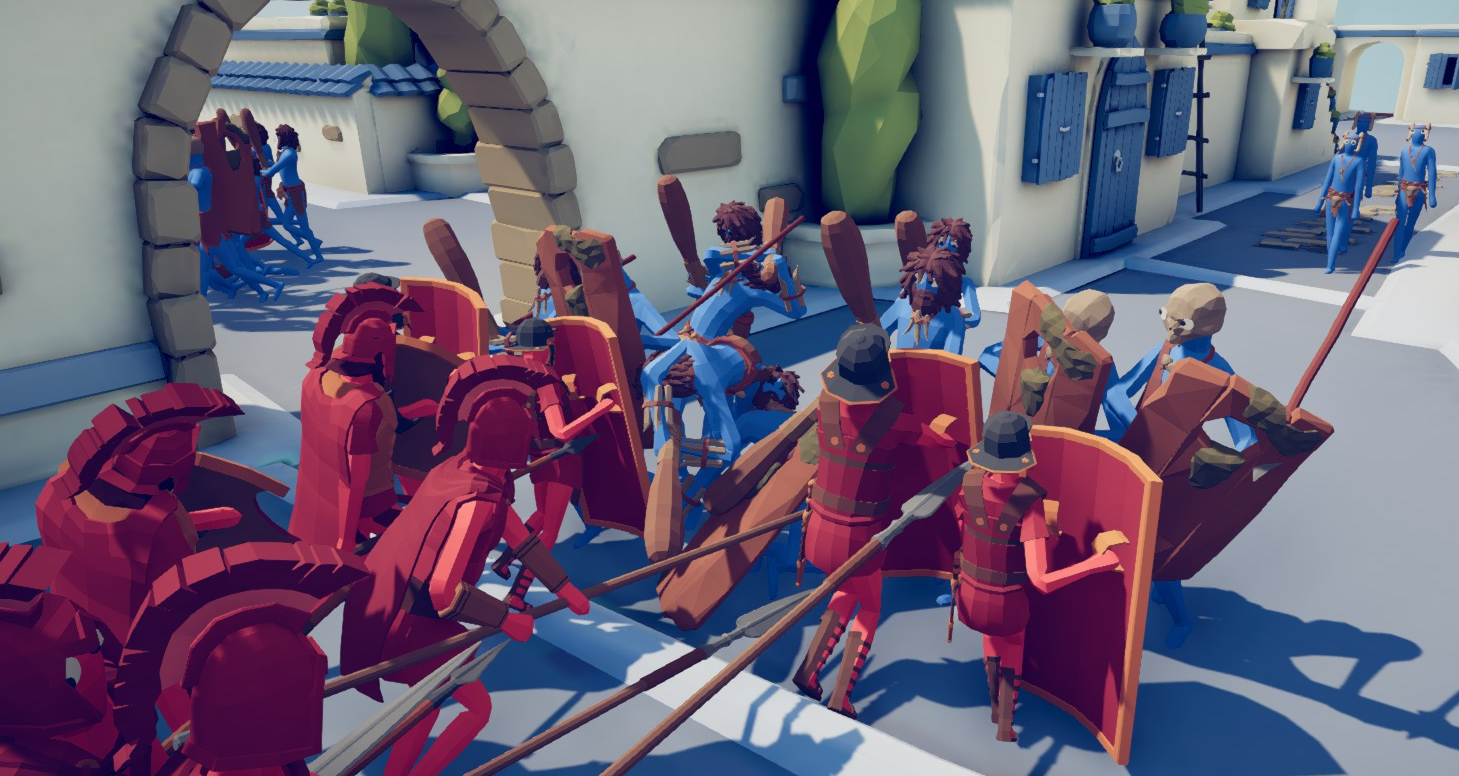
Totally Accurate Battle Simulator, Landfall Games
There are a couple of campaigns, collections of missions where you must create armies on limited budgets to defeat pre-made enemy armies across different maps, but the main goal of this game is once again the sandbox. This is made further evident by the Unit Creator tool, which allows players to make their own custom units and share them through the in-game workshop.
Units not being the size of a baby chicken does help a lot on the spectacle front, and here again we find the game focusing much more on the units themselves through the goofy physics-based ragdolly way they interact with each other and move around the world... but now the entire game is about the units. Is that bad? No, not really, but I feel like I've lost something by putting the whole focus on battles themselves.
You might be calling me a hypocrite. Isn't this whole thing about the battles? Well, yes. And no. It's about Little People Fighting. TABS and the Clay Soldiers Mod are in fact about little people fighting, but it's missing something. A reason to care about it, outside of the pure spectacle itself. Of course, there's roleplay, and trust me, I've done my fair share of roleplaying through these experiences, but that doesn't fill in the exact same emotional niche to me.
It's hard to grow attached to the Little People when they only exist when the fight happens, and cease existing once it is over. At least in Obliterate Everything, they had a base to protect, a goal to fight for, something somewhat meaningful. Here... it's too abstracted. It's toys! And there's nothing wrong with toys, but I feel as though we've gotten away from the ideal. I wish for Little People, not toys. The Little People need to have something to die for. You need to care about your Little People. You have to cry for them when they turn into paste.
LITTLE PEOPLE LIVING FOREVER
In Starsector, outside of the battle simulator and a few missions you can do to challenge your combat skills, all the fights you enter into fit inside of a much, much larger whole. When you attack a merchant fleet to try and steal their supplies, not only are there consequences through the damage your ships will be taking this fight, costing you a bit of resources, and the big hit your reputation will take with the faction that fleet is from, but you're also attacking a merchant fleet. You're disrupting the economy of the planet it was sent from, and the planet it was going to.
And sure, on a small scale, that's not much. What's a little piracy? Oh no, some middle-class shmuck on Kazeron isn't going to be able to get luxury goods for a few days, bummer!
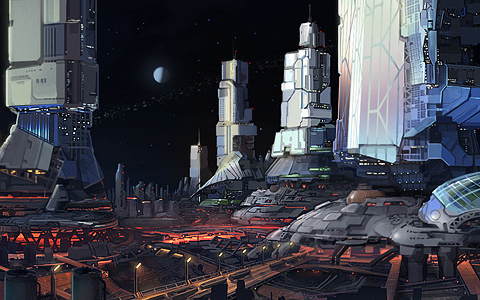
Every battle - especially in the Core Worlds - is important, not just for you but for the rest of the world too.
Your Little People are affecting the other Little People!
Well. Not exactly. You're affecting economic systems that are affecting the economic output of different planets where the population is represented by... a level. Hm. There isn't actually
that
much emotional investment related to the inhabitants of the world if you exclude the story missions. The emotional weight of the game is mostly carried by the semi-linear writing, not the game's systems. And that's fine! The writing is good! But that does mean I still don't find myself caring as much for the ships - or the ships' crews - as I could.
...How to remedy this?
It's eaaaasy!
MORE simulation.
Make EVERYTHING handled by Little People.
I want these Little People to have a SOUL in them.
Dwarf Fortress, Bay12Games
isn't exactly a strategy game, but it can sometimes be, a little. It's a colony management game where you start off with a bunch of little dwarves in a fully procedurally-generated world with hundreds of years of history, also generated procedurally, with thousands upon thousands of historical figures that the game all keeps track of one way or another, each one with their own procedurally-generated personality traits, factions, appearances, and so, so, so much more. You probably already knew that if you're reading this article, though. And if not, welcome!
Dwarf Fortress, more than any other game, is about the Little People created within and the worlds they inhabit. And that includes the wars they wage! The fights that break out in your taverns! The monster hunters that die in your caverns for glory! Everything they do! Anything they do! All of it, recorded forever by the game, remembered forever by you.
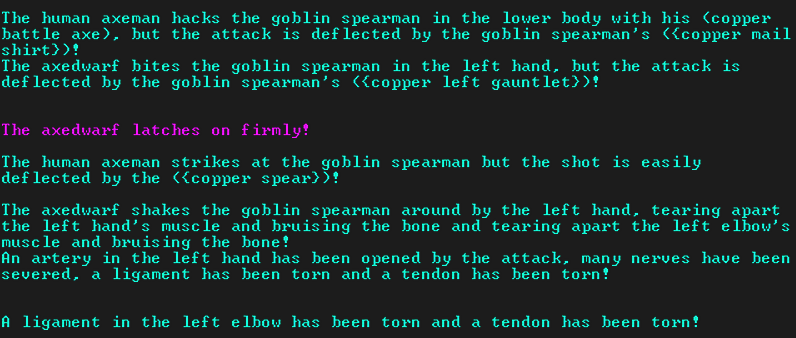
It is in this context that Little People fighting are at their peak. The visual spectacle is definitely a little different than what we got from those other games, but the text description of every single strike from one fighter onto another more than make up for that. And of course, the spectacle is in the surrounding context too; the fact that your soldiers fighting against those horrible invaders, or that enormous dragon, all have families and friends back in the fortress they care for, all things they want to protect. The fact that it took so long for you to get them armour and weapons, mined from the deepest depths of the Earth and forged by your wisest blacksmiths, your soldiers training for days and weeks and months to ensure they'd be strong enough to overcome the current threat. The fact that one of them is one of the first inhabitants of your fortress, who's spent years here, enduring every challenge thrown at 'em, someone who adopted a random sheep that were about to get slaughtered and now that sheep is waiting for them at home, and especially the fact that that same dwarf didn't even get a single hit in before getting their head sliced clean off.
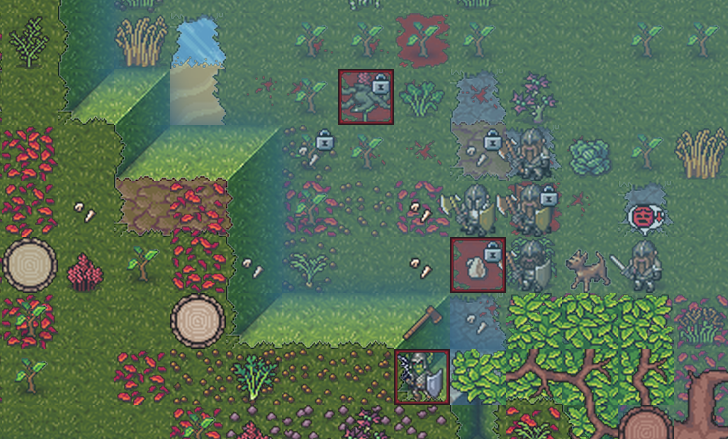
Pictured: a goblin attack going badly for the goblins
The fact that they'll spend most of their life not fighting, too! That's incredibly important! And, of course, the fact that they all act of their own accord. The only times you can truly direct dwarves is when giving them orders in battle, and even then they might just panic and run away, or eat something, or... I could go on.
Because this isn't actually only about Little People Fighting Forever. I'm fascinated with games with autonomous characters interacting with one another through complicated systems because I truly believe it is one of the best things video games can do. It's about not only what the player does, but also about how the game reacts to it. It's about how the player and the game work together to create a story.
And I genuinely believe these games all have elements of that, even if it might not be their focus! By virtue of having a central element of the game be automated, the player will end up looking at the screen, at their Little People fighting, and start to make up a story in that mess of explosions and wreckage and blood. Out of systemic chaos, the player exists to read through it all, make sense of it, and interpret a story out of it. More than other games, introducing elements not controlled by the player but still under the player's supervision will encourage them to read a story into something that previously had no meaning.
Really, that's what Dwarf Fortress is all about! A lot of things happen according to countless rules and systems, some of which have had their parameters changed by the player, and while thes events are meaningless from the point of view of the computer, the player is there to see it all happen and connect the dots.
These games have a lower degree of player interaction than others, but they still require a player, because otherwise, who would be there to make a story out of the systems?
Maybe that story is about little spaceships trying their best to defend their base while attacking the enemy's and the awesome maneuvers a few of them managed to pull off to avoid getting hit, or maybe that story is about clay soldiers fighting each other forever and the acts of bravery one can extract from that, or about a planet being blockaded and slowly collapsing over it, or about a dwarf going rogue in the tavern after one too many drinks and hearing the local bard sing a really bad song.
Or maybe it's about sending people into the war machine forever. That's also fun!
In memory of Christopher Wallis
All posts written from